Independent book project. Not affiliated with Revolut Ltd. Not financial, investment, legal or tax advice. Disclosures
Operator note · July 2026 · append-only mindset

The Merchant Network Is the Product

SumUp’s 5% cashback move, Revolut’s partner-marketplace opportunity, ANNA-style accounting intelligence, and the merchant AI node.

SumUpRevolut BusinessANNA.moneyMerchant AI NodeReality Scorecard
Thesis

The most underrated asset in fintech may not be the card, the account, or the licence. It may be the merchant (not a client base, but) network itself (as physical-presence infrastructure) — and the hardware, data, accounting, loyalty and AI layers that can be built on top of it.

The Revolut-SumUp 'flywheel' route

Revolut and SumUp are not simply competitors. They may be moving toward the same flywheel from opposite ends.

Revolut route

Consumer gravity → business services

Start with consumers, build trust and frequency, then extend into business accounts, acquiring, merchant tools, identity, banking infrastructure, and partner distribution.

SumUp route

Merchant gravity → consumer account

Start with offline merchants, own the till, then use the merchant network to make consumer banking feel local, rewarding, and useful.

ANNA route

Admin gravity → financial OS

Start with the pain nobody loves — tax, receipts, invoices, bookkeeping — and become the back-office intelligence layer for small businesses.

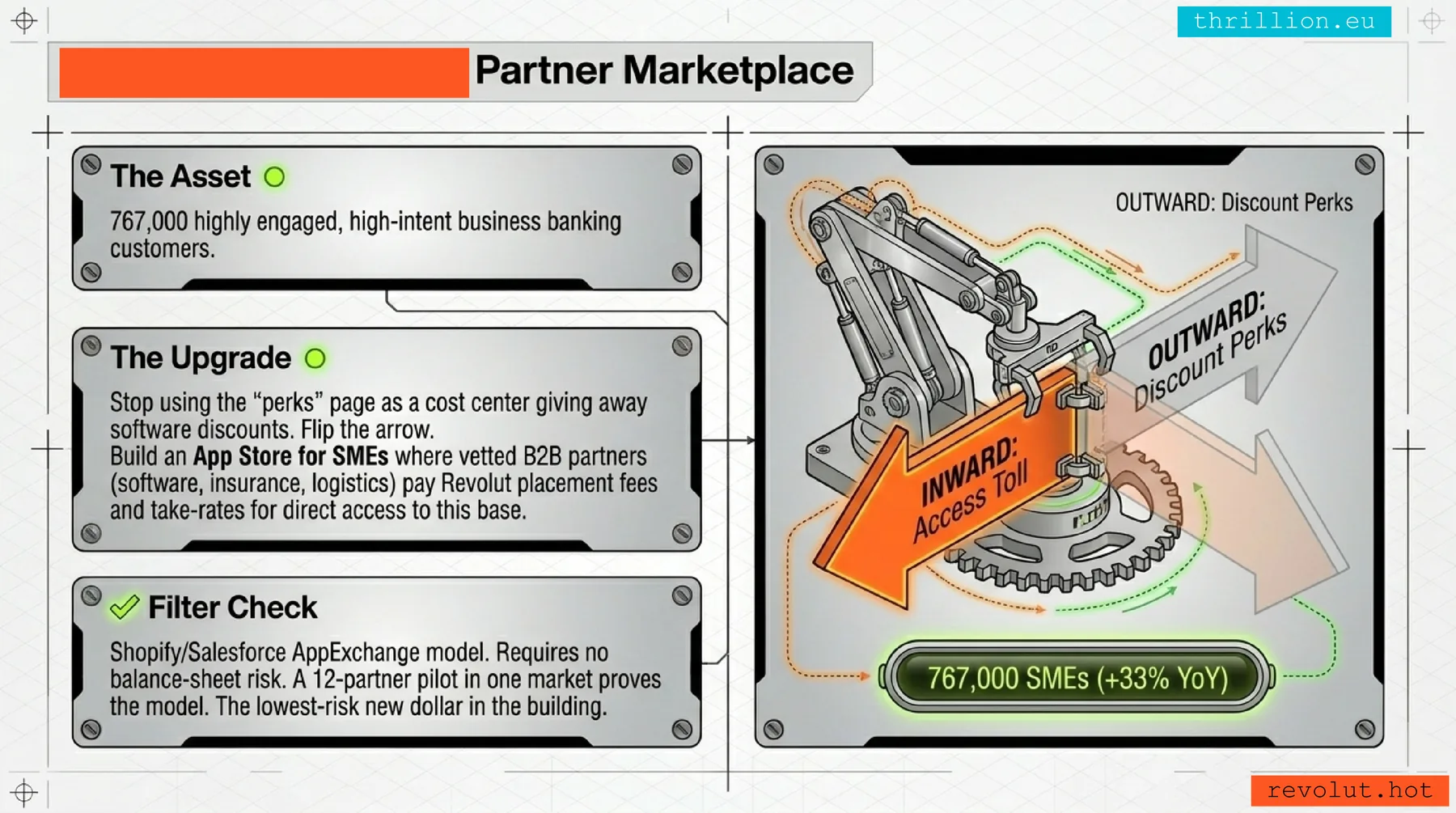
Revolut partner marketplace schematic showing inbound access toll logic for SME partners
Revolut-side translation: SumUp makes the merchant-network logic newly visible; Revolut's lowest-friction response is the partner marketplace already hiding inside Revolut Business.

The news

On 1 July 2026, SumUp launched consumer personal accounts in the UK, Ireland, Germany, France, Italy, and Spain.

The product offers up to 5% cashback at SumUp businesses, 2% at supermarkets, 0.5% on other purchases, zero-fee global spending, instant transfers, budgeting tools, and cards. SumUp frames the launch as a move from merchant payments provider toward a complete financial ecosystem for merchants and consumers.

Sifted adds the strategic detail: SumUp is also offering merchants no fees on transactions with SumUp consumer users. That makes the move a two-sided incentive system, not simply another consumer account.

A merchant network is not just where payments are processed. It is where demand can be routed.

The obvious read is too small

The obvious read is: “SumUp launched a neobank account.” The better read is: “SumUp is testing O2O: whether a merchant network can route consumers.”

LayerWhat it means
Merchant OSCard readers, POS, business accounts, invoices, online stores, loyalty, cash advance.
Merchant distributionCashback makes the merchant base visible to consumers; zero-fee transactions make consumers valuable to merchants.
Accounting intelligencePayments and invoices become tax, cash-flow and admin automation.
Merchant AI nodeA future hardware layer: local AI for merchants, not random consumer DePIN mining.
Layer

Merchant payments OS

This is the known SumUp.

Layer

Merchant-distribution network

Zero merchant fees make consumers visible as a cheaper payment rail.

Layer

Partner marketplace

The still-unbuilt layer: third-party partners paying to reach verified SMBs and to create new revenue lines for those merchants.

A merchant network is not just where payments are processed. It is where demand can be routed.

AI mini-PC / DePIN idea

From prosumer DePIN box to merchant AI node

The useful version is not “sell AI boxes to consumers and hope DePIN pays the loan.” The useful version is “SumUp can turn its merchant hardware relationship into an AI edge-appliance layer.”

No: prosumer AI&DePIN hardware as the core model

Too much demand uncertainty, regulatory contagion, hardware support, token complexity, and employee-debt toxicity. It is a beautiful idea with too many cliffs.

Conditional yes: merchant AI appliance

A 'sovereign' AI device (with AI models and agents) or managed local stack that helps merchants with receipts, accounting, inventory, menus, loyalty, customer support, local-commerce discovery, privacy-preserving inference and batch analytics.

DePIN can remain an optional partner layer for spare compute. It should not be the repayment engine, the regulatory thesis, or the reason to buy the device.

The Monday memo

What I would do next if I were inside the room.

For SumUp: make the cashback network discoverable — map, search, routes, local favourites, weekend errands, merchant stories.

For SumUp: give merchants a dashboard that shows fee savings, incremental consumer traffic, repeat visits, and category benchmarks.

For SumUp: treat accounting as the intelligence layer, not just a compliance utility.

For SumUp: test a merchant AI appliance as managed hardware: no token pitch, no “mining”, no regulated payment workloads.

For Revolut: do not merely copy cashback. Build the opposite wedge: a partner marketplace for the business base.

For ANNA: become the admin intelligence layer that makes the merchant OS legible: tax, receipts, invoices, payroll, MTD, cash-flow and agentic bookkeeping.

For identity / World ID players: watch the consent layer. Once merchants, consumers, partners and devices sit in the same network, reusable trust becomes economics.

What to watch

Consumer adoption.
Do users open the account only for signup rewards, or does SumUp become a daily wallet?
Merchant activation.
Do merchants actively push SumUp payments, or is the offer passive at the till?
Payment share.
What percentage of merchant transactions moves through SumUp consumer users?
Cashback economics.
Can 5% survive without becoming an expensive acquisition subsidy?
Discovery UX.
Does SumUp build the map, routing, and loyalty graph required to make the network visible?
Licensing.
If SumUp wants lending and investments, banking licences become more than optional infrastructure.

Scored, not asserted

The book tags its own claims — fact, inference, guess — and its postscript invites readers to score them against reality.

SumUp’s July move files the first entries. Direction of the SME-stack (“anti-Revolut”) thesis: confirmed. Consolidation as the mechanism: diverged, so far. Accounting as the stickiness layer: confirmed. The Revolut partner marketplace: still open.

The scoring itself lives in one place — an append-only ledger where verdicts are never edited, only amended with dates, and the misses stay on the board.

Open the Reality Scorecard →

Reality check

Borrowing the scorecard discipline

Partial

Claim: merchant network as distribution

SumUp confirms the direction, not the exact product.

The book’s Partner Marketplace thesis was about routing partners through verified businesses. SumUp’s move routes consumers through merchants. Same asset logic; different first wedge.

Confirmed

Claim: accounting is the sticky layer

SumUp × Sage makes the back office explicit.

The MTD product turns payments, invoices, expenses and banking data already inside SumUp into tax-compliance workflow. This supports the ANNA-style thesis without proving ANNA must be acquired.

Diverged

Claim: consolidation route

So far, partnership and organic build beat M&A.

The anti-Revolut idea may still require size. But the first strong data point is SumUp assembling the stack through product and partnership, not a visible merger.

Open

Claim: merchant AI edge node

The AI mini-PC idea gets a better home.

Consumer DePIN hardware remains weak. But a merchant-owned AI appliance next to POS, loyalty, accounting and cashback is now a more plausible SumUp wedge.
Disclosure / provenance

I (am biased) have historical relationships with this market. Via Life.SREDA I led SumUp’s 2014 funding round; I have also had an angel-investor-relationship with ANNA.money.

The point is not that I was large. I was not. The point is that I was early enough to care about this exact merchant-first thesis before it was fashionable — and to read this new SumUp move less as a press release than as a continuation of a very old question: what does a merchant network become when it stops being only a payments network?